Inside the Filter: Media, Flow and the Work They Do
Aquarium filters rely on more than a pump and a stack of cartridges. Learn what each type of media contributes, how water should pass through it, and how to avoid disrupting the filter’s biological work.
Aquarium filters rely on more than a pump and a stack of cartridges. Learn what each type of media contributes, how water should pass through it,…
Equipment · 8 min read
Is your aquarium filter just trapping debris, or is it also helping keep the water suitable for fish? The answer depends on what is inside the filter and how water moves through it. A filter can hold several kinds of media, each with a different job. But those materials only help if water reaches them in a useful order and the flow stays appropriate for the aquarium.
Think of filtration as a series of tasks, not a single cartridge doing everything. Mechanical media catches particles. Biological media provides surfaces where beneficial microorganisms can live. Chemical media can bind or remove particular substances. The pump moves water through the arrangement, carrying particles and dissolved material toward the media. Understanding those roles makes it easier to choose, arrange and maintain a filter without replacing useful parts unnecessarily.
Three Filter Jobs
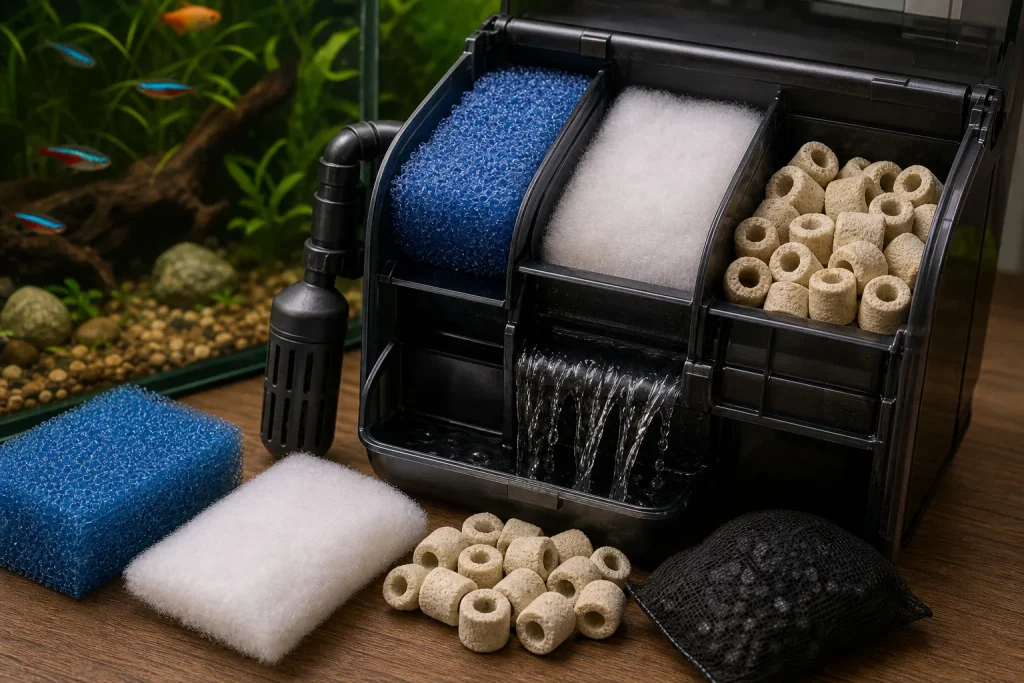
Mechanical filtration removes suspended debris from the water. A sponge, foam block, filter floss or a cartridge with a fibrous layer can catch fish waste, uneaten food and bits of plant material. This is the material that often turns brown or collects visible debris first.
Mechanical media does not make waste disappear. It holds particles until you clean or replace it. If it becomes clogged, water may move around it or take another path through the filter. That bypass can leave debris in the tank and reduce how much of the intended media receives flow. Rinse reusable foam in water removed during a water change when it needs cleaning. Replace disposable floss when it is packed with debris or no longer lets water pass freely.
Biological filtration supports microorganisms that process waste compounds produced in an aquarium. These organisms attach to surfaces in the filter, on the substrate, and elsewhere in the tank. Ceramic rings, porous blocks, bio balls and the interior of a sponge can all provide attachment surfaces. The name of the material matters less than whether it stays submerged or appropriately wet, receives oxygenated water, and is not stripped clean during routine care.
Biological media is not a chemical sponge that fills up and must be swapped on a schedule. Replacing all of it at once can remove much of the filter’s established microbial community. If media is damaged or must be changed, preserve some established material and follow the filter maker’s instructions. Avoid washing biological media under untreated tap water, since disinfectants used in municipal water may harm the organisms living on it. Use water from the aquarium or another suitable dechlorinated source for gentle rinsing if cleaning is needed.
Chemical filtration uses materials that bind, adsorb or otherwise remove specific substances. Activated carbon is a common example. It can remove some dissolved compounds, including residues from certain medications, but it is not a substitute for routine maintenance or biological filtration. Other specialty media are designed for particular water-quality needs. Use them for a clear reason, follow the product directions, and check whether they are compatible with any treatment you are using.
These categories can overlap in one physical item. A sponge catches particles while also offering surfaces for microorganisms. A cartridge may combine a mechanical layer with carbon and a plastic frame. Identify what each layer does before discarding it; the cartridge’s appearance does not tell you which parts are carrying the filter’s most useful biological activity.
Arrange Media By Flow
Most filters work best when water encounters coarse mechanical media before finer material. A coarse sponge catches larger debris without clogging as quickly. Finer floss can then trap smaller particles. Biological media typically sits after the main mechanical stage, where it receives water with fewer large particles but still gets steady flow. Chemical media, when needed, is often placed where water passes through it directly, according to the filter design and its directions.
Follow the path from the intake to the outlet rather than assuming every filter uses the same layout. In a hang-on-back filter, water usually enters through an intake tube, crosses the media chamber and spills back into the aquarium. In a canister filter, the route through trays depends on the model. A sponge filter draws water through its sponge and lifts it through an air-driven tube. The basic question is the same: does the water pass through the media, or can it slip around it?
Arrange media so it fits without leaving large gaps along the sides. Do not pack it so tightly that water cannot move through. If a cartridge or basket is designed to sit in a particular direction, use that arrangement. Avoid adding layers that block the pump intake or interfere with a lid, impeller or outlet. A filter that has been modified should still be easy to open and clean without mixing up the order of its media.
Imagine you have a hang-on-back filter with a coarse sponge, a small amount of floss and ceramic media. If the floss is placed first and catches every large leaf fragment, it may clog quickly. Moving the coarse sponge ahead of it gives larger debris a first stop; the floss can then polish the remaining suspended particles, while water continues to the ceramic media. The expected observable result is less debris reaching the finer layer and a filter that maintains its flow more consistently. This is an arrangement to consider, not a promise that every filter or aquarium will behave identically.
Why Flow Matters
Water movement brings oxygen and dissolved waste through the filter. If the flow is weak or blocked, less water reaches the media in a given period, and stagnant pockets can form inside a clogged unit. If water takes the easiest route around a tightly packed cartridge, the media may receive little contact even though the pump sounds as if it is running.
More flow is not automatically better. A strong current can make it difficult for some fish to rest or feed, and it can push floating plants or delicate leaves around. The right flow depends on the filter, aquarium layout and animals in the tank. Watch how fish behave in different areas, and check whether the outlet creates a current that reaches the whole aquarium without forcing fish to fight it constantly. A spray bar, outlet angle or prefilter sponge may help distribute or soften the flow, if compatible with the equipment.
Do not judge a filter only by the visible stream at the outlet. Check that the intake is unobstructed, the impeller is seated correctly and media is not blocking the water path. Make sure the filter is primed as directed. A rattling sound, intermittent output or sudden change in flow can point to trapped air, debris or a maintenance issue. Disconnect equipment from power before opening or cleaning it, and follow the manufacturer’s safety instructions.
Surface movement also matters because it helps exchange gases between aquarium water and the air above it. The outlet does not need to churn the entire tank, but gentle rippling at the surface is often useful. If the surface is completely still, adjust the outlet or circulation equipment in a way that suits the fish and plants. If the current is too forceful, redirect the outlet toward a wall or use a diffuser designed for the filter.
Keep Media Working
Clean media according to its condition and the filter’s design, not because every layer has reached the same point in a calendar routine. Mechanical material may need attention when debris is visible or flow begins to drop. Biological media generally needs less handling. Chemical media has a finite capacity, but the appropriate replacement interval depends on the product and the purpose for using it; consult its directions rather than guessing from appearance.
When cleaning, preserve the useful bacteria on biological surfaces. Rinse gently in removed aquarium water or dechlorinated water, and avoid scrubbing every surface until it looks new. Clean one part at a time if the filter contains multiple biological materials. Do not replace all established media during a single routine service unless a specific problem calls for it and you have a suitable plan for maintaining filtration.
If you use medications, check whether activated carbon or another chemical medium should be removed during treatment. Some media can remove the medication from the water. After treatment, the product directions or a qualified aquatic veterinarian can help clarify the next step. Do not rely on carbon to correct an unknown water-quality problem; identify the issue and address its cause.
Pay attention to media that has begun to crumble, come apart or lose its intended shape. Loose fibers can enter the pump or aquarium, while deteriorated foam may no longer trap debris effectively. Replace damaged material with a suitable product, but avoid changing the entire biological stage at once. If you are unsure which layer supports biological filtration, preserve it until you can identify its role.
Match Media To Needs
A simple filter often needs only durable mechanical and biological media. Adding more layers is not always an improvement. Extra material can restrict flow, complicate cleaning or create false confidence that a specific water problem is being treated. Start by identifying the job you need a medium to perform, then confirm that the filter can hold it without obstructing the intended path.
For a tank with visible plant fragments and food particles, a coarse prefilter sponge may catch debris before it reaches the pump. For water that remains cloudy with fine particles, a finer mechanical layer may help, provided it does not clog so quickly that flow suffers. For a specific dissolved contaminant, choose specialty media only when its purpose and compatibility are clear. If fish show distress or water quality is uncertain, use appropriate water tests and seek advice from an experienced aquarium professional or aquatic veterinarian rather than adding media at random.
Keep a simple note of what is in each filter compartment and which direction water travels. That record is useful when it is time to clean the unit, replace a worn layer or remove chemical media for treatment. A filter’s job is not to make water move through the greatest amount of material. It is to move water reliably through suitable media, with each layer doing the task it was chosen for.
Keep looking

Better Together: A Practical Guide to Coordinating an Online Gaming Team
A multiplayer session can unravel without anyone playing especially badly. One player starts a fight while…
When a Fish Hides: Reading Behavior Before Changing the Tank
A fish tucked behind a plant may be resting, avoiding a tankmate, or reacting to a…